Download A History of Ablaut in the Strong Verbs: From Caxton to the End of the Elizabethan Period (Classic Reprint) - H T Price | ePub
Related searches:
The Ablaut in English - JSTOR
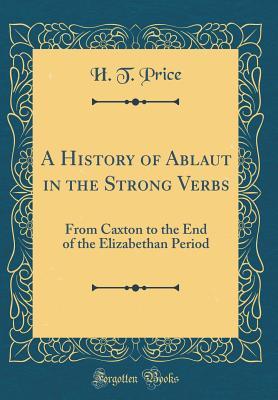
A History of Ablaut in the Strong Verbs: From Caxton to the End of the Elizabethan Period (Classic Reprint)
The Ablaut in High German - JSTOR
A History of Ablaut in the Strong Verbs from Caxton to the
A history of ablaut in the strong verbs from Caxton to the
Price, Hereward Thimbleby, 1880-1964 The Online Books Page
(PDF) Ablaut or Transfixation? On the Old English Strong
On the origin of the Germanic strong verb system Request PDF
Germanic strong verb - Languages on the Web
Islands of resilience: the history of the German strong verbs from a
Ablaut - definition of ablaut by The Free Dictionary
(PDF) Ablaut or Transfixation? On the Old English Strong Verbs
'Ablaut' in the Synchronic Phonology of the Old English Strong Verb
Ablaut and the Latin Verb - Elektronische Hochschulschriften der
Indo-European ablaut - Infogalactic: the planetary knowledge core
75 History of the verbal system During the EModE period it is
etymology - Irregular verbs: the history of the suffix “-en
The Germanic Strong Verbs – Foundations and Development of a
Germanic strong verb - Infogalactic: the planetary knowledge core
Title: Regional variation and change in the history of
First, the ablaut system of the strong verbs underwent simplification. The vowel distinction between past tense singular and past tense plural, which did not have a function anyway, was lost. This resulted in variation in the vowel in the past tense, as is here illustrated for the verb drink�.
X, 355 don ringe’s book from proto-indo-european to proto-germanic. A linguistic history of english, volume i is the first book of a planned comprehensive series on the history of the english language.
This vowel change in strong verbs is called either vowel gradation or by its originally german name: ablaut. While weak verbs were by no means new to proto-germanic or even proto-indo-european, they are still the only way to make new verbs, since a strong verb can only be added to the language by prefixing.
An example of ablaut in english is the strong verb sing, sang, sung and its related noun song, a paradigm inherited directly from the proto-indo-european stage of the language. All modern indo-european languages have inherited the feature, though its prevalence varies strongly.
By contrast, it is suggested in this paper that these two phenomena, namely the systematisation and functionalisation of two qualitative ablaut grades in the germanic strong verb and the reduction.
Strong verbs have their origin in the ancestral proto-indo-european (pie) language. In pie, vowel alternations called ablaut were frequent and occurred in many types of word, not only in verbs. The vowel that appeared in any given syllable is called its grade.
Related to ablaut and historical verb morphology, is presented in the appendices. Perfect ablaut: hysterokinetic, accentuated o-grade root in the strong stem.
A history of ablaut in the strong verbs from caxton to the end, of the elizabethan period [price, hereward thimbleby 1880-1964] on amazon. A history of ablaut in the strong verbs from caxton to the end, of the elizabethan period.
In the germanic languages, a strong verb is one which marks its past tense by means of ablaut.
A history of ablaut in the strong verbs from caxton to the end of the elizabethan period [1880-1964, price hereward thimbleby] on amazon. A history of ablaut in the strong verbs from caxton to the end of the elizabethan period.
What does ablaut mean? a vowel change, characteristic of indo-european languages, that accompanies a change in grammatical function; for exampl.
In particular, it is shown that the systemic position of ablaut is typologically different from that in the verb morphology of the indo-european parent language. Moreover, the origin of the lengthened grade preterits and other well-known morphological problems of the strong verbs are discussed.
A fuller description of ablaut operating in english, german and dutch verbs and of the historical factors governing these can be found at the article germanic strong verb. The same phenomenon is displayed in the verb tables of latin, ancient greek and sanskrit.
A history of ablaut in the strong verbs from caxton to the end of the elizabethan period by price, hereward thimbleby, 1880-1964.
Strong verbs of old english with their classification into seven classes and their categori- sation according to ‘ablaut vowels’, have constituted one of the most established and, so it 1 levin (1964, 156). 2 the paper presented at the abovementioned workshop was later published as mailhammer (2007b).
Historically, the split between classes i-iii and iv-v is accounted for in terms of a difference in the post-vocalic sequences in the root.
Add tags for a history of ablaut in the strong verbs from caxton to the end of the elizabethan period.
Introduction my attention was drawn to the morphological paradigms of the germanic strong verbs at a workshop on medieval english language and literature.
Category:old high german class 4 strong verbs: verbs where the ablaut vowel was followed by a sonorant (m, n, l, r) but no other consonant in proto-indo-.
Interesting results for the comparative grammar of these languages.
Be explained by the participation of strong german verbs in ablaut series. The root in question belongs to a particular set of vowel correspondences.
Price, hereward thimbleby, 1880-1964: a history of ablaut in class i of the strong verbs from caxton to the end of the elizabethan period.
Post Your Comments: