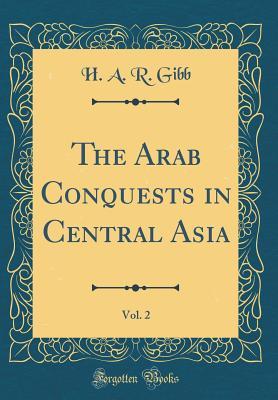
Read online The Arab Conquests in Central Asia, Vol. 2 (Classic Reprint) - H.A.R. Gibb | PDF
Related searches:
These alliances often harass or conquer the settled populations to the south, east� and west, both before and after the arab conquest of central asia.
14 mar 2015 islam came to central asia not long after its birth in the seventh century in the arabia.
Lost enlightenment: central asia's golden age from the arab conquest to tamerlane by frederick starr (review).
His preference for dwelling on lesser-known episodes like the conquest of central asia, rather than on such oft-related exploits as the capture of spain, is also more likely to please scholars.
The death of qutayba marked not merely the end of the arab conquests in central asia for a quarter of a century, but the beginning of a period of retrogression.
Many of the earliest books, particularly those dating back to the 1900s and before, are now extremely scarce and increas.
A valuable study of the early conquest of central asia, known as transoxia. Whilst the ummayads where busy conquering the maghrib and andalusia, persia�.
The first non-arabs to accept islam in large numbers were the persians, after the first shock of conquest, central asian resistance to the russians began.
Levi and ron sela draw from a vast array of historical sources to illustrate important aspects of the social, cultural, political, and economic history of islamic central asia.
This book may have occasional imperfections such as missing or blurred pages.
According to traditional accounts, the muslim conquests ( arabic: الغزوات , al-ġazawāt or arabic: الفتوحات الإسلامية , al-fatūḥāt al-islāmiyya) also referred to as the islamic conquests or arab conquests, began with the islamic prophet muhammad. He established a new unified polity in the arabian peninsula which under the subsequent rashidun (the rightly guided caliphs) and umayyad caliphates saw a century of rapid expansion of muslim power.
The early muslim conquests (الفتوحات الإسلامية , al-futūḥāt al-islāmiyya) also referred to as the arab conquests [4] and early islamic conquests [5] began with the islamic prophet muhammad in the 7th century. He established a new unified polity in the arabian peninsula which under the subsequent rashidun and umayyad.
While central asia has been a crossroads of cultures and religions throughout its history, there can be no question that islam has been a central feature of its cultural life for the past millennium. Islam arrived with the arab conquests of the early eighth century ce and over the next several centuries acquired a position of dominance.
Gibb brings out the fact that the resistance to the arabs was mainly the work of the local sedentary population (iranian or iranized) in the central asian oases. The loose usage of the name turk in the arabic sources has obscured the fact that the arabs had no serious.
Let's emphasize an instinctive impulse aiming to fill the geopolitical gap created by the collapse of the great tatar horde; a historical spirit of re-conquest with.
4 feb 2019 there are both narrow and broad notions of central asia. Prior to the russian conquest in the late 19th century the region did not possess 2) when, in the 7th century ad, arabs brought islam, the region was politica.
Herat and badghis submitted without a blow, and the first serious check to their advance was met in the murghab valley. A second expedition occupied juzjan, faryab, talaqan, and balkh, territories of afghanistan.
Arab soldiers initially crossed the oxus river (now amu darya) into transoxania (in today's present-day soviet uzbekistan) in 654, but it was not until 705, when qutaiba ibn muslim became umayyad governor of khorasan, that the arabs achieved real success in central asia.
0 0 0 summary many of the earliest books, particularly those dating back to the 1900s and before, are now extremely scarce and increasingly expensive. We are republishing these classic works in affordable, high quality, modern editions, using the original text and artwork.
The early muslim conquests (arabic: الفتوحات الإسلامية, al-futūḥāt al-islāmiyya) also referred to as the arab conquests and early islamic conquests began with the islamic prophet muhammad in the 7th century. He established a new unified polity in the arabian peninsula which under the subsequent rashidun and umayyad caliphates saw a century of rapid expansion.
Publication date 1923 topics bukhoro (uzbekistan) -- history publisher.
As a corollary to the muslim conquest of persia, the muslims became neighbors of the city states of transoxiana. Although transoxiana was included in the loosely defined turkestan region, only the ruling elite of transoxiana was partially of turkic origins whereas the local population was mostly a diverse mix of local iranian populat.
Preface thefirstdraftofthisworkwaspresentedtothe universityoflondonindecember1921,underthetitle ofthearabconquestoftransoxania,asathesisfor thedegreeofmasterofarts.
According to traditional accounts, the muslim conquests (arabic language: الغزوات , al-ġazawāt or arabic language: الفتوحات الإسلامية , al-futūḥāt al-islāmiyya) also referred to as the islamic conquests or arab conquests, began with the islamic prophet muhammad in the 7th century.
The arabs had reached central asia in the decade after their decisive victory in the battle of nihavend in 642, when they completed their conquest of the former.
This work was presented to the university of london in december 1921, under the title of “the arab conquest of transoxania “, as a thesis for the degree of master of arts, and was approved by the senate in january 1922, for publication as such. During the year my attention was taken up in other continue reading.
These documents—many newly translated and most not readily available for study—cover the period from the 7th-century arab conquests to the 19th-century.
Start by marking “ lost enlightenment: central asia's golden age from the arab conquest to tamerlane.
Cities such as samarkand and penjikent flourished right down to the arab conquests in central asia in the early eighth century.
A very clear and superb description of the arab arrival into the mediterranean area and into central asia as far as samarkand. Divided into intependent chapters according to the waves of occupation of various parts of the eastern empire, with a clear explanation of why this conquest met such a fast success and why the eastern empire and sassanian persia were in no condition to oppose resistance.
From the mid-seventh century, muslim arab armies from saudi arabia began to travel north into central asia and west across africa, invading the countries they passed. The sasanian empire, exhausted from many years of war with the romans, was spectacularly defeated and iran and iraq were soon conquered. By the 680s, the arab armies were able to continue into tranoxania, and were eventually to reach as far as the borders of china, beginning a new era of islamic rule over.
Central asia's golden age from the arab conquest to tamerlane, princeton/ oxford: “princeton university.
The arab conquests in central asia; the arab conquests in central asia.
La trace de rome dans le desert de syrie: le limes de trajan à la conquête arabe; recherches aériennes (1925–1932).
Lost enlightenment: central asia's golden age from the arab conquest to tamerlane.
17 oct 2014 lost enlightenment: central asia's golden age from the arab conquest to he was educated at the middle east technical university.
Search for library items search for lists search for contacts.
Bbc’s “in our time,” on the arab conquests of the 600-700s ce, when, in little more than a century, islamic civilization expanded from its arabian heartland, across northern african and the sahara, reaching well into western europe. Mongols in world history housed at columbia university, this is an excellent site.
The conquest of central asia by the muslim arabs the conquest of turkestan, or central asia, by muslim arabs is one of the most important events.
To surn up the position in central asia in the years i~nmecliaielyfollowing qutayba's conquests�(1) lower tukharistan and cliaghznisn formed an integral part of the arab einpire. (2) tnklialistxn, now in the decay of its power, was hcld as a vassal state, together with the transoxine provinces oi icliuttal, icum~cih,etc.
Conversion of the warlike and nomadic turkish peoples in central asia began in the eighth and ninth centuries; they began to migrate to the middle east in the tenth and eleventh centuries.
A succession of nomadic tribes, the last and lnost powerful of which were a branch of the yueh-chi, were driven down into sogdiana. It is now generally held that these tribes were of aryan origin, though the question is not perhaps settled with absolute certainty.
Under the rashidun there were the conquests of syria (637), armenia (639), egypt (639) and north africa (652). Under the umayyads the continuing conquest of north africa (665), the second arab siege of constantinople (717-718) and the conquest of tbilisi (736).
From the mid-seventh century, muslim arab armies from saudi arabia began to travel north into central asia and west across africa,.
The arab conquest from the mid-seventh century, muslim arab armies from saudi arabia began to travel north into central asia and west across africa, invading the countries they passed. The sasanian empire, exhausted from many years of war with the romans, was spectacularly defeated and iran and iraq were soon conquered.
Frederick starr's lost enlightenment: central asia's golden age from the arab conquest to tamerlane.
3 oct 2020 request pdf the arab conquest of central asia numerous competing arab and non-arab tribes were brought together by the skillful politics.
How arabs conquered central asia and central asia then set the stage to conquer baghdad.
24 oct 2016 fred starr discusses his book on central asia's golden age, from the arab conquest to tamerlane.
8 apr 2020 free kindle book and epub digitized and proofread by project gutenberg.
Post Your Comments: