Read Temperature-Responsive Polymers: Chemistry, Properties, and Applications - Vitaliy V Khutoryanskiy | PDF
Related searches:
Temperature-Responsive Polymers: Properties, Synthesis, and
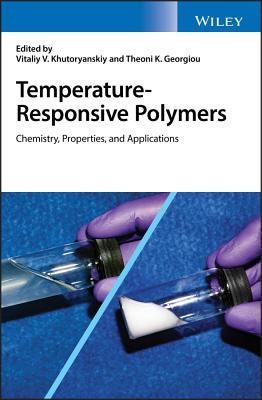
Temperature-Responsive Polymers: Chemistry, Properties, and Applications
Thermo-responsive polymers and their application as smart
Temperature-responsive polymers: Synthesis, properties, and
Temperature-responsive polymers: properties, synthesis and
Buy Temperature-Responsive Polymers: Chemistry, Properties, and
Temperature-, Light-, and Host-Molecule-Responsive Polymers with
Temperature-responsive polymers: Properties, synthesis and
Temperature-Responsive Polymers : Chemistry, Properties and
The thermo-responsive polymers are those, which are associated with temperature stimulus. While fever due to the presence of pyrogens/microorganisms the body temperature is elevated.
In - buy temperature-responsive polymers: chemistry, properties, and applications book online at best prices in india on amazon.
3 dec 2019 for example, we have converted poly(acylic acid), a water-soluble polymer, into a thermoresponsive polymer with a ucst behavior in aqueous.
8 nov 2013 the most notable thermoresponsive polymers used in drug-delivery systems exhibit lower critical-solution temperature (lcst) characteristics.
Poly (n -isopropylacrylamide) (pipaam), which is a well-known temperature-responsive polymer, has been grafted on tissue culture polystyrene (tcps) surfaces through an electron beam irradiated polymerization. At 37 °c, where the pipaam modified surface is hydrophobic, cells can adhere, spread on the surface and grow to confluence.
This review presents smart thermo-responsive polymers and discusses how they polymers that are either lower critical solution temperature-type, upper critical.
Written for polymer scientists in both academia and industry as well as postgraduate students working in the area of stimuli-responsive materials, this vital text offers an exploration of the chemistry, properties and current applications of temperature-responsive polymers.
Novel temperature-responsive polymers as flocculants and collectors in froth flotation figures and tables from this paper figures and tables references.
With contributions from a distinguished panel of experts, temperature-responsive polymers puts the focus on hydrophilic polymers capable of changing their physicochemical properties in response to changes in environmental temperature.
With contributions from a distinguished panel of experts, temperature-responsive polymers puts the focus on hydrophilic polymers capable of changing their physicochemical properties in response to changes in environmental temperature. The contributors review the chemistry of these systems, and discuss a variety of synthetic approaches for preparation of temperature-responsive polymers, physicochemical methods of their characterisation and potential applications in biomedical areas.
Certain polymers with a particular molecular structure undergo phase transition behavior in water at temperatures above and below a specific value known as the lower critical solution temperature (lcst). At temperatures above the lcst, the hydrophobic bonds within and between the molecules strengthen and the polymer chains aggregate (the aggregated polymer chains appear cloudy in water).
A common example is poly(n-isopropyl acrylamide) (pnipam), a temperature- responsive polymer which remains hydrophilic in solution when maintained below.
10 feb 2017 the next step was to see if the temperature-responsive polymer-modified liposomes displayed good cellular uptake.
Interest in temperature-responsive polymers has steadily grown over the past several decades, and numerous studies have been dedicated to developing temperature sensitive polymers that can be constructed into new smart materials for biomedical applications. Phase behavior of a temperature-responsive polymer plays a pivotal role in determining its biological performance in certain conditions.
A temperature-responsive polymer will undergo volume phase transitions at certain temperatures-the so-called lower critical solution temperature (lcst) and upper critical solution temperature.
Temperature-responsive polymers or thermoresponsive polymers are polymers that exhibit a drastic and discontinuous change of their physical properties with.
An authoritative resource that offers an understanding of the chemistry, properties and applications of temperature-responsive polymers with contributions from a distinguished panel of experts, temperature-responsive polymers puts the focus on hydrophilic polymers capable of changing their physicochemical properties in response to changes in environmental temperature.
25 oct 2020 temperature-responsive polymer brushes consist of surface grafted polymer chains which are able to change their properties sharply upon.
Temperature-responsive self-assembly (trsa) of polymer-stabilized nanoparticles is a promising method that is useful for many applications. Currently, polymers ligands with a lower critical solution temperature are used for trsa, which requires the use of specific polymer–solvent couples.
Among this group of smart polymeric materials, thermoresponsive polymers' ability to change their physical properties, in response to changes to the surrounding.
An authoritative resource that offers an understanding of the chemistry, properties, and applications of temperature-responsive polymers with contributions from a distinguished panel of experts, temperature-responsive polymers puts the focus on hydrophilic polymers capable of changing their physicochemical properties in response to changes in environmental temperature.
Alternatively, a different type of thermoresponsive polymers, albeit not as common as the lcst-type, is known as upper critical solution temperature ( ucst).
The majority of recent reports on thermoresponsive polymers evaluate the phase transition temperature at a certain polymer concentration by turbidity.
The physical properties of smart polymeric materials change according to environmental factors, such as temperature, ph, light, electric or magnetic fields. Among this group of smart polymeric materials, thermoresponsive polymers’ ability to change their physical properties, in response to changes to the surrounding temperature, render them one of the most interesting materials, as temperature is an easily accessible and controllable parameter, and is also of great relevance in biomedical.
Temperature-responsive polymers are especially interesting since variations in temperature can be applied externally in a non-invasive manner.
With contributions from a distinguished panel of experts, temperature- responsive polymers puts the focus on hydrophilic polymers capable of changing their.
Our analysis suggests that other peptides or polymers should also form temperature-responsive coacervates with ntps (or ndps and nmps), and a similar dependence of c s * on temperature is expected for these other peptide–nucleotide coacervates.
Temperature-responsive polymers or thermoresponsive polymers are polymers that exhibit a drastic and discontinuous change of their physical properties with temperature. The term is commonly used when the property concerned is solubility in a given solvent, but it may also be used when other properties are affected. Thermoresponsive polymers belong to the class of stimuli-responsive materials, in contrast to temperature-sensitive materials, which change their properties continuously with environm.
An authoritative resource that offers an understanding of the chemistry, properties and applications of temperature-responsive polymers. With contributions from a distinguished panel of experts, temperature-responsive polymers puts the focus on hydrophilic polymers capable of changing their physicochemical properties in response to changes in environmental�.
Post Your Comments: